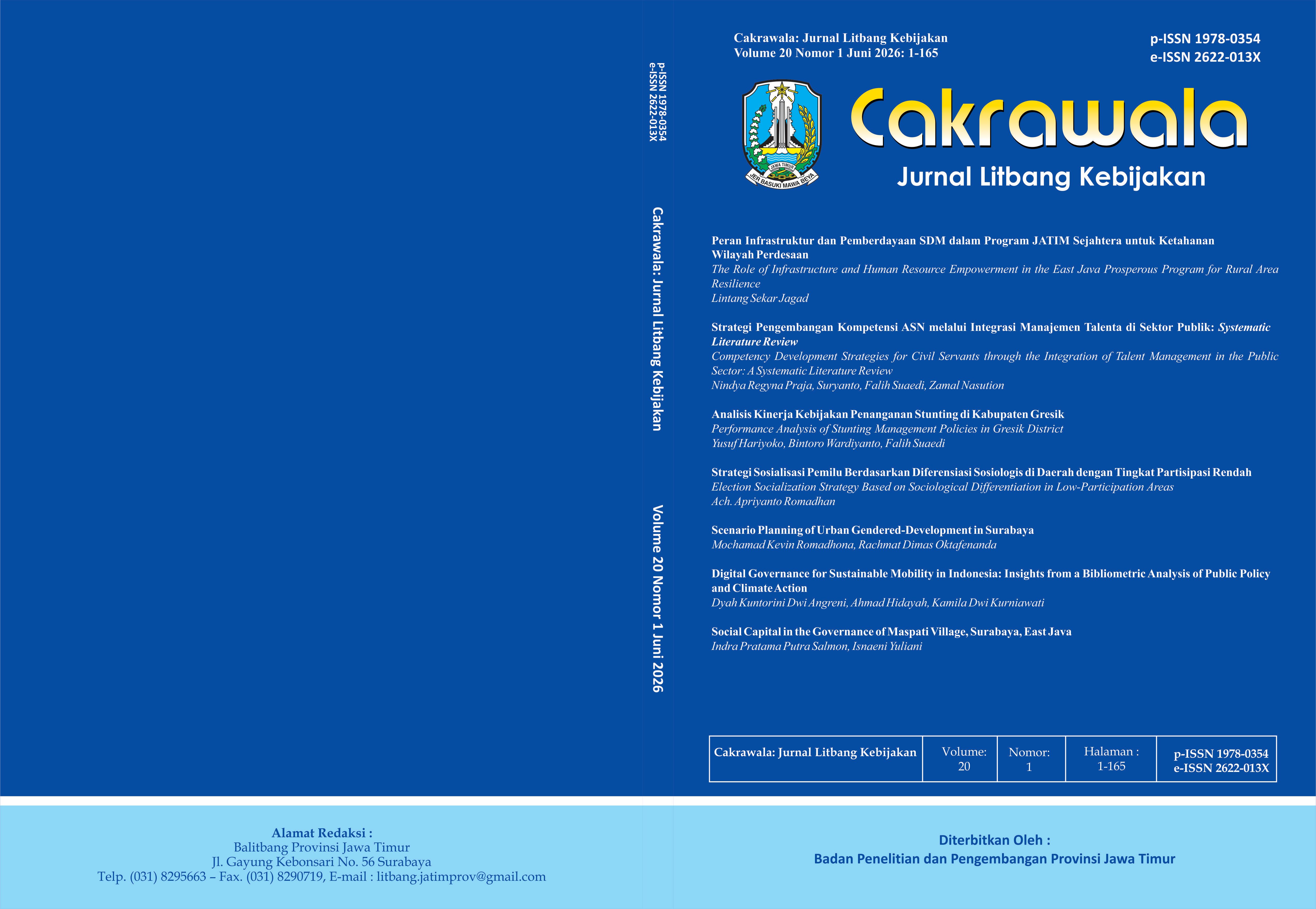
Scenario Planning of Urban Gendered-Development in Surabaya
DOI:
https://doi.org/10.32781/cakrawala.v20i1.907Keywords:
Gender Equity, Women Empowerment, Gender Development Index, SDGsAbstract
This study investigates the development of gender equality in Surabaya by analysing the Gender Development Index (GDI) from 2020 to 2023 and projecting its trajectory until 2025. Employing a quantitative-descriptive approach, the research utilises secondary data obtained from Badan Pusat Statistik Surabaya and applies linear regression analysis to examine trends in gender equality across the dimensions of health, education, and economic achievement. The findings demonstrate a consistent increase in the GDI, from 93.58 in 2020 to 95.56 in 2023, reflecting gradual progress toward gender parity despite the persistence of disparities between men and women, particularly in income distribution and political participation. The regression model further predicts continued improvement, with projected GDI values reaching 96.17 in 2024 and 96.86 in 2025. The novelty of this study lies in its integration of statistical trend analysis with a gender-governance perspective to evaluate not only numerical progress but also the structural challenges underlying gender inequality in an urban Indonesian context. This research contributes to the discourse on gender mainstreaming by providing empirical projections of gender equality at the municipal level and offering policy-oriented insights for strengthening gender-responsive governance in support of the achievement of Sustainable Development Goal 5 on gender equality by 2030.
References
Ababneh, A., Lok, K. L., Abdeyazdan, H., Opoku, A., & Chen, C. (2025). Gender equality in smart sustainable cities: Literature review. Frontiers in Sustainable Cities, 7, 1535561. https://doi.org/10.3389/frsc.2025.1535561.
Alber, G. (2024). A Novel Approach to Work Towards Gender-Responsive Urban Climate Policy. Environment and Urbanization, 36(1), 133–146. https://doi.org/10.1177/09562478241230037.
Aldhi, I. F., Suhariadi, F., Rahmawati, E., Supriharyanti, E., Hardaningtyas, D., Sugiarti, R., & Abbas, A. (2025). Bridging Digital Gaps in Smart City Governance: The Mediating Role of Managerial Digital Readiness and the Moderating Role of Digital Leadership. Smart Cities, 8(4), 117. https://doi.org/10.3390/smartcities8040117.
Anttiroiko, A.-V., Valkama, P., & Bailey, S. J. (2014). Smart Cities in the New Service Economy: Building Platforms for Smart Services. AI & SOCIETY, 29(3), 323–334. https://doi.org/10.1007/s00146-013-0464-0.
Araujo, A. S. D., Bugs, G. T., Barros, J., Massucheto, J., Alves, P., & Feitosa, F. D. F. (2026). Risk en Route: Women’s Mobility and Exposure to Gender-Based Violence in Public Spaces in Curitiba, Brazil. Urban Studies, 63(7), 1576–1594. https://doi.org/10.1177/00420980251400626.
Arora, D., Braunstein, E., & Seguino, S. (2023). A Macro Analysis of Gender Segregation and Job Quality in Latin America. World Development, 164, 106153. https://doi.org/10.1016/j.worlddev.2022.106153.
Asteria, D., Jap, J. J., & Utari, D. (2020). A Gender-Responsive Approach: Social Innovation for the Sustainable Smart City in Indonesia and Beyond. Journal of International Women’s Studies, 21(6), 193–207.
Avakyan, Y., Bywater, K., Gleason, A., Gordon, C., & Johansson, S. (2026). Gender Mainstreaming & Other Development Fantasies. In A. Dulhunty & S. Bessell (Eds.), Gender and Development: Perspectives from Australia and the Pacific. Springer Nature Singapore. https://doi.org/10.1007/978-981-95-4842-2_14.
Bello, J., & Stephen, S. (2026). Toward Stealth Construction: Integrating Risk Management Practices Into Sustainable and Inclusive Smart City Development. Future Smart Cities. Elsevier. https://doi.org/10.1016/B978-0-443-33667-6.00008-2.
Börjeson, L., Höjer, M., Dreborg, K.-H., Ekvall, T., & Finnveden, G. (2006). Scenario Types and techniques: Towards a User’s Guide. Futures, 38(7), 723–739. https://doi.org/10.1016/j.futures.2005.12.002
BPS. (2023). Gender Development Index and Gender Empowerment Index in Indonesia. Badan Pusat Statistik Indonesia.
BPS Kota Surabaya. (2025). Kota Surabaya Dalam Angka 2025 (1102001.3578). Badan Pusat Statistik Kota Surabaya.
Burke, J., Lombard, W., Lachance, L., Kelly, P., Wilken, M., & Waddell, S. (2017). Using a Gender‐Responsive Approach to Generate Policy, Systems, and Environmental Changes to Improve Women’s Health. World Medical & Health Policy, 9(3), 358–376. https://doi.org/10.1002/wmh3.236.
Bussolo, M., Ezebuihe, J. A., Muñoz Boudet, A. M., Poupakis, S., Rahman, T., & Sarma, N. (2024). Social Norms and Gender Disparities with a Focus on Female Labor Force Participation in South Asia. The World Bank Research Observer, 39(1), 124–158. https://doi.org/10.1093/wbro/lkad010.
Cascella, C., Williams, J., & Pampaka, M. (2022). An Extended Regional Gender Gaps Index (eRGGI): Comparative Measurement of Gender Equality at Different Levels of Regionality. Social Indicators Research, 159(2), 757–800. https://doi.org/10.1007/s11205-021-02764-x.
Cassola, A., Watson, L. K., Gloppen, S., Caceres, A. M., & Hoffman, S. J. (2026). Adaptation of Global Gender Norms in the Strategies, Policies, and Guidelines of International Humanitarian Organisations: A Comparative Analysis of the International Rescue Committee and the International Federation of Red Cross and Red Crescent Societies. The International Journal of Human Rights, 1–33. https://doi.org/10.1080/13642987.2026.2655812.
Chant, S. (2013). Cities Through A “Gender Lens”: A Golden “Urban Age” for Women in the Global South?. Environment and Urbanization, 25(1), 9–29. https://doi.org/10.1177/0956247813477809.
Chant, S. & McIlwaine, C. (2016). Cities, Slums and Gender in the Global South: Towards a Feminised Urban Future. Routledge. https://doi.org/10.4324/9781315862996.
Cheema, S. (2020). Governance for Urban Services: Towards Political and Social Inclusion in Cities. In S. Cheema (Ed.), Governance for Urban Services (pp. 1–30). Springer Singapore. https://doi.org/10.1007/978-981-15-2973-3_1.
Cornwall, A., & Rivas, A.-M. (2015). From ‘Gender Equality and ‘Women’s Empowerment’ to Global Justice: Reclaiming a Transformative Agenda for Gender and Development. Third World Quarterly, 36(2), 396–415. https://doi.org/10.1080/01436597.2015.1013341.
Creswell, J. W. (2017). Research Design. Qualitative, Quantitative, and Mixed Methods Approaches (5th edition (international student edition)). SAGE Publications.
Creswell, J. W., & Clark, V. L. P. (2017). Designing and Conducting Mixed Methods Research. Sage publications.
Das, A. K. (2020). Gender-Responsive Public Transport. In W. Leal Filho, A. Marisa Azul, L. Brandli, P. Gökçin Özuyar, & T. Wall (Eds.), Sustainable Cities and Communities. Springer International Publishing. https://doi.org/10.1007/978-3-319-95717-3_106.
Das, J. N. (2024). Empowering Progress: The Interplay of Women’s Political Participation and Development Dynamics. Springer Nature Singapore. https://doi.org/10.1007/978-981-96-0986-4_17
De Snyder, V. N. S., Friel, S., Fotso, J. C., Khadr, Z., Meresman, S., Monge, P., & Patil-Deshmukh, A. (2011). Social Conditions and Urban Health Inequities: Realities, Challenges and Opportunities to Transform the Urban Landscape Through Research and Action. Journal of Urban Health, 88(6), 1183–1193. https://doi.org/10.1007/s11524-011-9609-y.
Dhamija, G., Roychowdhury, P., & Shankar, B. (2025). Does Urbanization Empower Women? Evidence from India. Journal of Population Economics, 38(1), 27. https://doi.org/10.1007/s00148-025-01085-4.
Dhar, S. (2018). Gender and Sustainable Development Goals (SDGs). Indian Journal of Gender Studies, 25(1), 47–78. https://doi.org/10.1177/0971521517738451.
Dijkstra, A. G., & Hanmer, L. C. (2000). Measuring Socio-Economic GENDER Inequality: Toward an Alternative to the UNDP Gender-Related Development Index. Feminist Economics, 6(2), 41–75.
Diliani, D. S. N. A., & Susanti, D. S. (2015). A Female Leader in Executive Service: The Case of Mayor Risma of Surabaya. Emerald Group Publishing Limited. https://doi.org/10.1108/S2053-769720150000024012.
Ernawati, R. (2013). Facing Urban Vulnerability Through Kampung Development, Case Study of Kampungs in Surabaya. Humanities and Social Sciences, 1(1), 1. https://doi.org/10.11648/j.hss.20130101.11.
Fauziyah, I., Akbar, B., Effendy, K., & Lukman, S. (2020). Implementation of Gender Mainstream Policy in the Implementation of the Duties and Functions of People’s Representatives of the Republic of Indonesia. Journal of Public Administration and Governance, 10(3), 73-90.
Felipe, J. (2010). Inclusive Growth, Full Employment, and Structural Change: Implications and Policies for Developing Asia. Anthem Press.
Fenster, T. (2005). The Right to the Gendered City: Different Formations of Belonging in Everyday Life. Journal of Gender Studies, 14(3), 217–231. https://doi.org/10.1080/09589230500264109.
Ferdous, J., & Eslamian, S. (2026). Social Inclusion and Environmental Concerns in a Sustainable Age. Wiley. https://doi.org/10.1002/9781394248087.ch53.
Bishu, S. G. (2022). Womens Representation in Public Sector Organizations: Persistent Challenges and Potential for Change. Edward Elgar Publishing.
Grbić, M. (2026). The Effects of Local Economic Development on Reducing Regional Inequality: The Role of Local Governments. Springer Nature Switzerland. https://doi.org/10.1007/978-3-032-04265-1_12
Grusky, D. B., & Hill, J. (Eds.). (2018). Inequality in the 21st Century: A Reader (1st ed.). Routledge. https://doi.org/10.4324/9780429499821.
Gu, C. (2019). Urbanization: Processes and Driving Forces. Science China Earth Sciences, 62(9), 1351–1360. https://doi.org/10.1007/s11430-018-9359-y.
Gupta, S. T., Kumar, N., & Kumar, P. (2025). Women’s Safety and Empowerment: E-Governance as a Catalyst for Social Transformation. IGI Global. https://doi.org/10.4018/979-8-3373-0817-3.ch005.
Gupta, S. T., Kumar, N., & Kumar, P. (2025). Women’s Safety and Empowerment: E-Governance as a Catalyst for Social Transformation. Startup-Driven E-Government (pp. 111–132). IGI Global. https://doi.org/10.4018/979-8-3373-0817-3.ch005.
Hackl, A. (2018). Mobility Equity in a Globalized World: Reducing Inequalities in the Sustainable Development Agenda. World Development, 112, 150–162. https://doi.org/10.1016/j.worlddev.2018.08.005.
Healey, P. (2020). Collaborative planning: Shaping Places in Fragmented Societies. Bloomsbury Publishing.
Heise, L., Greene, M. E., Opper, N., Stavropoulou, M., Harper, C., Nascimento, M., Zewdie, D., Darmstadt, G. L., Greene, M. E., Hawkes, S., Heise, L., Henry, S., Heymann, J., Klugman, J., Levine, R., Raj, A., & Rao Gupta, G. (2019). Gender Inequality and Restrictive Gender Norms: Framing the Challenges to Health. The Lancet, 393, 2440–2454. https://doi.org/10.1016/S0140-6736(19)30652-X.
Holmes, H., Karampour, K., Richardson, R., & Burgess, G. (2025). Housing, Poverty, and Digital Exclusion: The Multiple Ways in which Digital Inequalities and Housing Inequalities Intersect. Housing Studies, 1–21. https://doi.org/10.1080/02673037.2025.2577727.
Ibourk, A., & Hninou, S. (2025). Empowering Women Through Agricultural Cooperatives: A Multilevel Analysis in Morocco’s Marrakech-Safi region. Discover Sustainability, 6(1), 559. https://doi.org/10.1007/s43621-025-01245-2.
Ida, R., Kinasih, S. E., Febriyanti, S. N., Puspa, R., & Romadhona, M. K. (2024). A Holistic Inquiry Into Risk Communication Dynamics: Youth-Led Initiatives And Societal Engagement In Surabaya’s Rural Landscapes. Kumawula: Jurnal Pengabdian Kepada Masyarakat, 7(2), 348-399. https://doi.org/10.24198/kumawula.v7i2.52052.
Ida, R., Kinasih, S. E., Wahyudi, I., & Romadhona, M. K. (2025). Women’s Involvements in Communication Forum for Disaster Management and Resilience in Eruption of Mount Semeru, Lumajang, East Java. Discover Social Science and Health, 5(1), 1-21. https://doi.org/10.1007/s44155-025-00307-0.
Jenson, J. (2015). The Fading Goal of Gender Equality: Three Policy Directions that Underpin the Resilience of Gendered Socio-economic Inequalities. Social Politics: International Studies in Gender, State & Society, 22(4), 539–560. https://doi.org/10.1093/sp/jxv035.
Kabeer, N. (1999). Resources, Agency, Achievements: Reflections on the Measurement of Women’s Empowerment. Development and Change, 30(3), 435–464. https://doi.org/10.1111/1467-7660.00125.
Kalaoane, R. C., & Matamanda, A. R. (2024). Women in the Urban Informal Economy and Pathways Towards Inclusive Cities. Edward Elgar Publishing.
Khan, Z. (2023). Gender-Responsive Budgeting. Springer International Publishing. https://doi.org/10.1007/978-3-030-22767-8_141.
Kinasih, S. E., Romadhona, M. K., & Oktafenanda, R. D. (2025). Menuju Kesetaraan Gender di Surabaya, Indonesia. Jurnal Registratie, 7(2), 158–175. https://doi.org/10.33701/jurnalregistratie.v7i2.5564.
Kitchin, R. (2023). Urban Data Power: Capitalism, Governance, Ethics, and Justice. Bristol University Press. https://doi.org/10.51952/9781529233551.ch002.
Koengkan, M., Georgescu, I., Auza, A., Apaydın, Ş., & Uzuner, G. (2026). Exploring the Influence of Female Political Participation on CO₂ and Greenhouse Gas Emissions: Insights from the European Union. International Journal of Environmental Research, 20(1), 9. https://doi.org/10.1007/s41742-025-00935-z.
Kougias, C., & Papadakaki, M. (2026). Rethinking the ‘Smart City’: From Technology-Led Visions to Citizen-Centered Governance Barriers and Pathways in Digital Urban Initiatives. Journal of Urban Affairs, 48(5), 1581–1604. https://doi.org/10.1080/07352166.2025.2502116.
Kulshreshtha, M. (2026). Gender Transformative Strategies for Social-Ecological Transformation in Urban India. Springer Nature Singapore. https://doi.org/10.1007/978-981-95-6188-9_4.
Kumar, C., & Pandey, V. (2021). Access to Education and Gender Equality. Springer International Publishing. https://doi.org/10.1007/978-3-319-95687-9_17.
Kumari, R. (2018). Economic Growth, Disparity, and Determinants of Female Labor Force Participation: A Research Agenda. World Journal of Entrepreneurship, Management and Sustainable Development, 14(2), 138–152. https://doi.org/10.1108/WJEMSD-03-2017-0009.
Kvale, S., & Brinkmann, S. (2009). InterViews: Learning the Craft of Qualitative Research Interviewing (2. ed). Sage.
Libertun De Duren, N. (2022). Gender Inequalities in Cities: Inclusive Cities. Springer International Publishing. https://doi.org/10.1007/978-3-030-87745-3_48.
Listiani, H. D., Sukesi, K., & Wike, W. (2025). Amplifying Feminism Through the Empowerment Program Kartini Corner: A Gender Mainstreaming Endeavour in Rural Indonesia. Waskita: Jurnal Pendidikan Nilai Dan Pembangunan Karakter, 9(1), 96–109. https://doi.org/10.21776/ub.waskita.2025.009.01.7.
Lozano-Torres, Y. (2021). The Quest for Gender Equality: Understanding and Measuring Gender Responsi-veness in Colombia’s Municipal Planning. Cities, 119, 103358. https://doi.org/10.1016/j.cities.2021.103358.
Lu, J., & Fei, R. (2026). Climate-Resilient City Construction as an Enabling Pathway to Smart City Development: An Empirical Assessment. Sustainable Cities and Society, 141, 107277. https://doi.org/10.1016/j.scs.2026.107277.
Mehra, R. (1997). Women, Empowerment, and Economic Development. The ANNALS of the American Academy of Political and Social Science, 554(1), 136–149.
Mirzoev, T., Tull, K. I., Winn, N., Mir, G., King, N. V., Wright, J. M., & Gong, Y. Y. (2022). Systematic Review of the Role of Social Inclusion within Sustainable Urban Developments. International Journal of Sustain-able Development & World Ecology, 29(1), 3–17. https://doi.org/10.1080/13504509.2021.1918793.
Moayedfar, S., Akhavansadr, S., Taheri, P., Tayebi, S., & Sharifi, A. (2026). Mapping Local Perspectives on Specialized Healthcare: Insights from Five Global Cities. Health & Place, 98, 103637. https://doi.org/10.1016/j.healthplace.2026.103637.
Moser, C. (2012). Gender Planning and Development: Theory, Practice and Training. Routledge.
Nanni, G. (2023). Gender Equality, Equity, and Equal Opportunities. Springer International Publishing. https://doi.org/10.1007/978-3-031-41486-2_1.
Natarajan, M., Kim, E., Solymosi, R., & Babu, D. (2026). Mapping Sexual Harassment in Public Places: Open-Source Data-Driven Contextual Analysis. Violence Against Women, 10778012251411830. https://doi.org/10.1177/10778012251411830.
Ngo, Q. D., Nguyen, Q. H., & Vu, C. (2025). Envisioning Future Workforce Adaptability: A Multi‐Layered Analysis of Skills Ecosystems in Vietnam’s Emerging Economy. Futures & Foresight Science, 7(1), e70000. https://doi.org/10.1002/ffo2.70000.
Novovic, G. (2023). Gender Mainstreaming 2.0: Emergent Gender Equality Agendas Under Sustainable Development Goals. Third World Quarterly, 44(5), 1058–1076. https://doi.org/10.1080/01436597.2023.2174848.
Odyuo, M., & Thangkhiew, D. W. (2025). What Determines the Socio-economic Vulnerability of Women in the Informal Sector? Insights from a Case Study of Vendors in Nagaland, India. The International Journal of Community and Social Development, 7(1), 31–56. https://doi.org/10.1177/25166026251319162.
OECD. (2020). Cities in the World: A New Perspective on Urbanisation. OECD Publishing.
Paramaiah, Ch., Kamruddin, S., Katuri, P. K., Nalluri, V., Kumar, V. V. A., Chang, J.-R., & Bhimavarapu, A. (2026). Assessing Interlinkages Between Sustainable Urbanization and Economic Inequality Using an Integrated AHP-DEMATEL-TOPSIS Approach. Urban Science, 10(3), 164. https://doi.org/10.3390/urbansci10030164.
Pareek, P., Hajra, R., & Mohapatra, H. (2025). Empowering Public Officials by Bridging the Digital Divide With Smart Technology for Public Services. IGI Global. https://doi.org/10.4018/979-8-3693-6547-2.ch016.
Perrin, F. (2022). Can the Historical Gender Gap Index Deepen our Understanding of Economic Development?. Journal of Demographic Economics, 88(3), 379–417. https://doi.org/10.1017/dem.2020.34.
Pierre, J. (2011). The Politics of Urban Governance. Bloomsbury Publishing.
Pratiwi, A. M., McQuaid, K., & Vanderbeck, R. M. (2026). Gender, Vulnerability, and Power in Indonesia’s Climate Policies. Climate Policy, 1–17. https://doi.org/10.1080/14693062.2026.2645652.
Prihatiningtyastuti, E., Dayaram, K., & Burgess, J. (2022). Examining Gender Mainstreaming in Indonesia: A Feminist Policy Analysis. Edward Elgar Publishing. https://doi.rg/10.4337/9781800379008.00024
Putri, M. K., & Anggraini, E. K. (2025). Theoretical Foundations Related to Gender and Digital Entre-preneurship. Springer Nature Singapore. https://doi.org/10.1007/978-981-95-1148-8_3.
Rahman, A., Rosandi, V. B., Indraprahasta, G. S., Prasetyadi, A., Saputra, A. Y., & Pravitasari, A. E. (2026). Rural Transformation Research: Current State, Dynamics, and Future Directions. Area, 58(1), e70049. https://doi.org/10.1111/area.70049.
Ramadani, R. Y., Tjitrawati, A. T., Romadhona, M. K., Narwati, E., & Kinasih, S. E. (2023). The Rights to Health for All: Is Indonesia Fully Committed to Protected Refugees and Asylum Seekers?. Jurnal Hubungan Luar Negeri, 8(2), 55–80. https://doi.org/10.70836/jh.v8i2.11.
Rani, U., Castel-Branco, R., Satija, S., & Nayar, M. (2022). Women, Work, and the Digital Economy. Gender & Development, 30(3), 421–435. https://doi.org/10.1080/13552074.2022.2151729.
Rasool, S. (2017). Gender Equality and Social Development. Palgrave Macmillan US. https://doi.org/10.1057/978-1-137-44598-8_7.
Rauniyar, G., & Kanbur, R. (2010). Inclusive Growth and Inclusive Development: A Review and Synthesis of Asian Development Bank Literature. Journal of the Asia Pacific Economy, 15(4), 455–469. https://doi.org/10.1080/13547860.2010.517680.
Renzi, A., & Frenzel, J. (2025). Localized Processes of Platformization: The Example of Surabaya. Big Data & Society, 12(2), 20539517251338776. https://doi.org/10.1177/20539517251338776.
Risman, B. J. (2018). Gender as a Social Structure. Springer International Publishing. https://doi.org/10.1007/978-3-319-76333-0_2.
Romadhona, M. K. (2022). Does the Pandemic Affect Unemployment Rate in East Java? (A Study of Pre and Post COVID-19 Pandemic in 2016 to 2021). The Journal of Indonesia Sustainable Development Planning, 3(2), 164–176. https://doi.org/10.46456/jisdep.v3i2.308.
Romadhona, M. K., Khasanah, S. U., Ariadi, S., Kinasih, S. E., & Tjitrawati, A. T. (2023). Re-Defining Stunting in Indonesia 2022: A Comprehensive Review. Jurnal Inovasi Ilmu Sosial dan Politik (JISoP), 5(1), 56–63.
Romadhona, M. K., Kinasih, S. E., Oktafenanda, R. D., Sugiarti, E., & Baqer Alfadhel, A. B. (2026). The Indonesia’s Paradox of Refugees Rights to Health. International Journal on Minority and Group Rights, 1–32. https://doi.org/10.1163/15718115-bja10279.
Romadhona, M. K., & Oktafenanda, R. D. (2025). Bridging the Poverty Gap: Innovative-Based Policy Approaches in East Java. Jurnal Pembangunan Daerah, 1(2), 21–38.
Romadhona, M. K., Oktafenanda, R. D., & Kinasih, S. E. (2024). Assessing Corporate Social Responsibility From the Perspective of the Local Community. ASEAN Journal of Community Engagement, 8(1). 59-72. https://doi.org/10.7454/ajce.v8i1.1196.
Romadhona, M. K., Subagyono, B. S. A., & Agustin, D. (2022). Examining Sustainability Dimension in Corporate Social Responsibility of ExxonMobil Cepu: An Overview of Socio-Cultural and Economic Aspects. Journal of Social Development Studies, 3(2). 128-141. https://doi.org/10.22146/jsds.5038.
Rubin, M. M., & Bartle, J. R. (2022). Gender-Responsive Budgeting: A Global Perspective. Edward Elgar Publishing.
Rubin, M. M., & Bartle, J. R. (2023). Gender‐Responsive Budgeting: A Budget Reform to Address Gender Inequity. Public Administration, 101(2), 391–405. https://doi.org/10.1111/padm.12802.
Salim, W., & Drenth, M. (2020). Local Governance and Access to Urban Services: Political and Social Inclusion in Indonesia. Springer Singapore. https://doi.org/10.1007/978-981-15-2973-3_7.
Sanders, C. K., & Scanlon, E. (2021). The Digital Divide Is a Human Rights Issue: Advancing Social Inclusion Through Social Work Advocacy. Journal of Human Rights and Social Work, 6(2), 130–143. https://doi.org/10.1007/s41134-020-00147-9.
Santosa, H. (2000). Environmental management in Surabaya with reference to National Agenda 21 and the social safety net programme. Environment and Urbanization, 12(2), 175–184.
Sari, D. P., Nailufar, F., Anwar, K., & Rahmah, M. (2024). Fenomena Indeks Pembangunan Gender (IPG) dan Indeks Pemberdayaan Gender (IDG) dalam Meningkatkan Partisipasi Angkatan Kerja Wanita di Indonesia. Jurnal Ekonomi Regional Unimal, 7(3), 25–34.
Schoemaker, P. J. (1995). Scenario Planning: A Tool for Strategic Thinking. MIT Sloan Management Review.
Shantiko, B., Liswanti, N., Bourgeois, R., & Laumonier, Y. (2021). Land-use Decisions in Complex Commons: Engaging Multiple Stakeholders through Foresight and Scenario Building in Indonesia. Environmental Management, 68(5), 642–664. https://doi.org/10.1007/s00267-021-01470-1.
Shen, J., & Liu, H. (2026). Disparity and Convergence in Multi-Dimensional Urban form Evolution: Unraveling Typical Urban Development Modes in Wuhan Metropolitan Area. International Journal of Environmental Science and Technology, 23(2), 140. https://doi.org/10.1007/s13762-025-06849-9.
Shirleyana, S., Hawken, S., & Sunindijo, R. Y. (2018). City of Kampung: Risk and Resilience in the urban communities of Surabaya, Indonesia. International Journal of Building Pathology and Adaptation, 36(5), 543–568. https://doi.org/10.1108/IJBPA-02-2018-0025.
Song, W., Yang, W., Wang, N., Wang, C., Li, Z., Ou, Y., & Zhang, X. (2024). How does Industrial Transformative Process Shape the Spatial Dynamics of Urban Development?. Land Use Policy, 138, 107015. https://doi.org/10.1016/j.landusepol.2023.107015.
Kinasih, S. E., Romadhona, M. K., Hennida, C., Suwito, K. A., & Alfadhel, A. B. B. (2025). Gender-based Education to Addressing Child Marriage. Jurnal Pengabdian Hukum Indonesia (Indonesian Journal of Legal Community Engagement) JPHI, 8(2), 569–616. https://doi.org/10.15294/jphi.v8i2.23633.
Solomon, D. S., Singh, C., & Islam, F. (2021). Examining the Outcomes of Urban Adaptation Interventions on Gender Equality Using SDG 5. Climate and Development, 13(9), 830–841. https://doi.org/10.1080/17565529.2021.1939643.
Suryahadi, A., Al Izzati, R., Suryadarma, D., & Dartanto, T. (2023). How Inequality Affects Trust in Institutions: Evidence from Indonesia. Asian Economic Policy Review, 18(1), 73–91. https://doi.org/10.1111/aepr.12401.
Tacoli, C., & Satterthwaite, D. (2013). Gender and urban change. Environment and Urbanization, 25(1), 3–8. https://doi.org/10.1177/0956247813479086.
Tjitrawati, A. T., & Romadhona, M. K. (2023). Affliction in the Post Palu Disaster: State Failure to Implement Human Rights Standard on Disaster Management. Cogent Social Sciences, 9(1), 2233255. https://doi.org/10.1080/23311886.2023.2233255.
Tjitrawati, A. T., & Romadhona, M. K. (2025). Re-Assessing Human Rights Issues in Palu Disaster Management: An International Legal Foundation. Journal of Southeast Asian Human Rights, 9(1), 81–121. https://doi.org/10.19184/jseahr.v9i1.46166.
Tjitrawati, A. T., Romadhona, M. K., Moechthar, O., & Kinasih, S. E. (2024). The Palu Disaster and Indonesia’s Obligation to Ensure the Right of Adequate Housing and Land Rights: Mission Accomplished?. Brill Nijhoff. https://doi.org/10.1163/9789004706477_011.
Ula, Z. M., Hayati, A., Hakim, M. N., & Pakiding, H. A. P. (2026). Exploring Boundaries: Understanding Spatial Dynamics in Kajoetangan Heritage Tourism Kampung. Urban Policy and Research, 1–24. https://doi.org/10.1080/08111146.2026.2647844.
UN Women. (2020). Gender-Responsive Urban Planning and Design. UN Women.
UN-Habitat. (2022). World Cities Report 2022: Envisaging the Future of Cities. United Nations Human Settlements Programme.
Villamejor-Mendoza, M. F. (2020). Competitive cities: Implications for better public service. Policy Design and Practice, 3(4), 445–461. https://doi.org/10.1080/25741292.2020.1832741.
Wicaksono, L. P., Kamariyah, S., Dwijosusilo, K., & Mustofa, A. (2025). Local Government Policies for Empowering Heritage Tourism in Surabaya’s Old City. Socious Journal, 2(5), 15–27.
Yorucu, V., Bekun, F. V., & Yitmen, I. (2026). Urban Resilience in Smart Cities: Lessons and Insights from a Global Perspective. Springer Nature Switzerland. https://doi.org/10.1007/978-3-032-05715-0_10.
Zainol, R., & Noor, N. M. (2026). Introduction: Framing the Future of Asian Cities. Springer Nature Switzerland. https://doi.org/10.1007/978-3-032-01016-2_1.
Zhuang, Y., Yang, D., & Han, Q. (2025). Technological Transformation and Digital Inclusion: A Scoping Review of Marginalized Groups’ Access to and Experience With Ict-Driven Public Services in Smart Urbanism. Sustainable Cities and Society, 134, 106899. https://doi.org/10.1016/j.scs.2025.106899.
Downloads
Published
How to Cite
Issue
Section
Citation Check
License
Copyright (c) 2026 Sri Endah Kinasih, Mochamad Kevin Romadhona, Rachmat Dimas Oktafenanda

This work is licensed under a Creative Commons Attribution 4.0 International License.