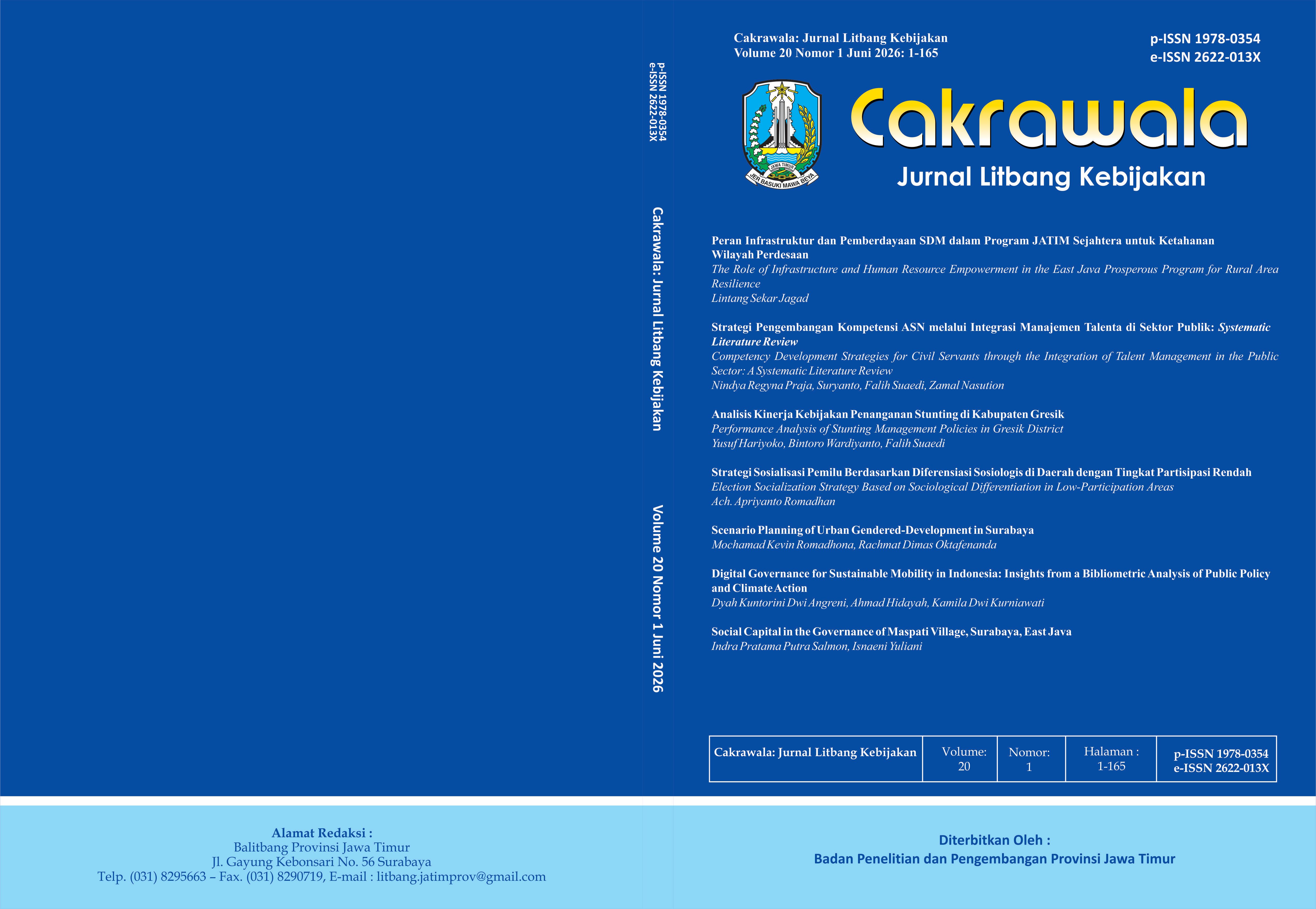
Social Capital in the Governance of Maspati Village, Surabaya, East Java
DOI:
https://doi.org/10.32781/cakrawala.v20i1.968Keywords:
Heritage Tourism, Kampung Lawas Maspati, Social Capital, Surabaya City, Tourism VillageAbstract
The inadequate identification of the local community’s social capital pattern has adversely affected the management of Maspati Village in Surabaya City, which has been operational and emerged as an alternative model for urban tourism villages in Indonesia. In the wake of the pandemic, social capital has continued to weaken as communities have shifted their focus from managing urban tourism villages, which had previously served as a primary source of income, to seeking new economic opportunities in order to survive. This study employed a case study approach, focusing on Maspati Village in Surabaya City as the research object. The informants included the community, stakeholders of the tourism village (managers), as well as MSMEs and home industries. The primary focus centers on the functioning of social capital in the management of urban tourism villages, highlighting the importance of fostering community trust, shared values, and a mutual understanding of common goals. Data were collected through interviews, FGDs, document analysis, and exploration of supporting secondary data. The collected data were further analyzed interactively. The results were validated using triangulation techniques. The findings indicated 1) a decline in community trust, evidenced by a lack of interest in advancing the tourism village due to limited tourist visits and stagnation in local tourism development; 2) a decrease in shared values, particularly in norms that previously attracted tourists; 3) a diminished understanding of initial goals, especially in tourism management, which, albeit fundamentally understood, are now perceived as irrelevant, leading to a lack of adherence to these goals.
References
Anele, K. K. (2021). Assessing the Impact of COVID-19 on the Indonesian Tourism Industry. Journal of Indonesian Tourism, Hospitality and Recreation, 4(2), 107-120. https://doi.org/10.17509/jithor.v4i2.34393.
Azzahra, A. A., & Romadhona, M. (2022). Implementasi Desain Font “Kampung Lawas” pada Gapura sebagai Identitas Visual Kampung Lawas Maspati Surabaya. Amarasi: Jurnal Desain Komunikasi Visual, 3(1), 1-8. https://doi.org/10.59997/amarasi.v3i01.1039.
Baud-Bovy, M., & Lawson, F. (1998). Tourism and Recreation: Hand-book of Planning and Design. Oxford: Architectural Press.
Boggio, P. S., Wingenbach, T. S. H., da Silveira Coêlho, M. L., Comfort, W. E., Marques, L. M., & Alves, M. V. C. (Eds.). (2023). Social and Affective Neuroscience of Everyday Human Interaction: From Theory to Methodology. Springer. https://doi.org/10.1007/978-3-031-08651-9.
Bovaird, T., & Löffler, E. (Eds.). (2015). Public Management and Gover-nance. Routledge.
Braesemann, F., & Stephany, F. (2021). Between Bonds and Bridges: Evidence from a Survey on Trust in Groups. Social Indicators Research, 153(1), 111-128. https://doi.org/10.1007/s11205-020-02471-z .
Briant, C. (2018). Government Versus Governance: Structure Versus Process. EchoGeo, 43, 1-6. https://doi.org/10.4000/echogeo.15288.
Bromley, D. W., & Cernea, M. M. (1989). The Management of Common Property Natural Resources: Some Conceptual and Operational Fallacies (World Bank Discussion Paper No. 57). World Bank.
Budiarti, B. E., & Rahmatin, L. S. (2024). Partisipasi Masyarakat dalam Pengembangan Kampung Lawas Maspati sebagai Community Based Tourism. JIIP-Jurnal Ilmiah Ilmu Pendidikan, 7(7), 6725-6733. https://doi.org/10.54371/jiip.v7i7.5333.
Butler, R. (2022). Measuring Tourism Success: Alternative Considerations. Worldwide Hospi-tality and Tourism Themes, 14(1), 11-19. https://doi.org/10.1108/WHATT-10-2021-0133.
Carmen, E., Fazey, I., Ross, H., Bedinger, M., Smith, F. M., Prager, K., McClymont, K., & Morrison, D. (2022). Building Community Resilience in a Context of climate Change: The Role of Social Capital. Ambio, 51(6), 1371-1387. https://doi.org/10.1007/s13280-021-01678-9.
Creswell, J. W., & Poth, C. N. (2016). Qualitative Inquiry and Research Design: Choosing Among Five Approaches. Sage Publications.
Emerson, K., Nabatchi, T., & Balogh, S. (2012). An Integrative Framework for Collaborative Governance. Journal of Public Administration Research and Theory, 22(1), 1-29. https://doi.org/10.1093/jopart/mur011.
Fafurida, F., Purwaningsih, Y., Mulyanto, M., & Suryanto, S. (2023). Tourism Village Development: Measuring the Effectiveness of the Success of Village Development. Economies, 11(5), 133. https://doi.org/10.3390/economies11050133 .
Field, J. (2016). Social Capital. UK: Routledge.
Harrison, J. L., Montgomery, C. A., & Bliss, J. C. (2016). Beyond the Monolith: The Role of Bonding, Bridging, and Linking Social Capital in the Cycle of Adaptive Capacity. Society & Natural Resources, 29(5), 525-539. https://doi.org/10.1080/08941920.2015.1103389.
Huppé, G. A., Creech, H., & Knoblauch, D. (2012). The Frontiers of Networked Governance. International Institute for Sustainable Development.
Karabulut, G., Bilgin, M. H., Demir, E., & Doker, A. C. (2020). How Pandemics Affect Tourism: International Evidence. Annals of tourism research, 84, 102991. https://doi.org/10.1016/j.annals.2020.102991.
Keping, Y. (2018). Governance and Good Governance: A New Framework for Political Analysis. Fudan Journal of the Humanities and Social Sciences, 11, 1-8. https://doi.org/10.1007/s40647-017-0197-4.
Kim, J. J., & Han, H. (2022). Redefining in-Room Amenities for Hotel Staycationers in the New Era of Tourism: A Deep Dive Into Guest Well-Being and Intentions. International Journal of Hospitality Management, 102, 103168. https://doi.org/10.1016/j.ijhm.2022.103168.
King, B., Fielke, S., Bayne, K., Klerkx, L., & Nettle, R. (2019). Navigating Shades of Social Capital and Trust to Leverage Opportunities for Rural Innovation. Journal of Rural Studies, 68, 123-134. https://doi.org/10.1016/j.jrurstud.2019.02.003.
Knollenberg, W., Arroyo, C. G., Barbieri, C., & Boys, K. (2021). Craft Beverage Tourism Development: The Contributions of Social Capital. Journal of Destination Marketing & Management, 20, 100599. https://doi.org/10.1016/j.jdmm.2021.100599.
Kristiana, Y., Pramono, R., & Brian, R. (2021). Adaptation Strategy of Tourism Industry Stakeholders During the COVID-19 Pandemic: A Case Study in Indonesia. The Journal of Asian Finance, Economics and Business, 8(4), 213-223. https://doi.org/10.13106/jafeb.2021.vol8.no4.0213.
Larasati, N. K. R., & Rahmawati, D. (2017). Sustainable Cultural Tourism Development Strategy in Maspati Traditional Village, Surabaya. ITS Engineering Journal, 6(2), C183-C187.
Lo, C. (2018). Between Government and Governance: Opening the Black Box of the Transformation Thesis. International Journal of Public Administration, 41(8), 650-656. https://doi.org/10.1080/01900692.2017.1295261.
Mason, P. (2020). Tourism Impacts, Planning and Management. Routledge.
Mujahidin, M. D., Warsono, W., Wisnu, W., Alrianingrum, S., Suprijono, A., Harmanto, H., & Sain, Z. H. (2026). Integrating the Hexahelix Model and Culturally Community-Based Tourism (CCBT) in the Development of Sustainable Urban Ecotourism: A Study of Kampung Lawas Maspati in Surabaya. Socius: Jurnal Penelitian Ilmu-Ilmu Sosial, 3(12), 431-445.
Nag, N. S. (2018). Government, Governance and Good Governance. Indian Journal of Public Administration, 64(1), 122-130. https://doi.org/10.1177/0019556117735448.
Noviyant, U. D. E., Aly, M. N., & Fiatiano, E. (2018). Potential Development of Maspati Lawas Tourism Village as Surabaya’s New Tourism Destination. Journal of Applied Science in Tourism, 3(2), 218-231.
Nunkoo, R. (2017). Governance and Sustainable Tourism: What is the Role of Trust, Power and Social Capital?. Journal of Destination Marketing & Management, 6(4), 277-285. https://doi.org/10.1016/j.jdmm.2017.10.003.
Panday, S., Rushton, S., Karki, J., Balen, J., & Barnes, A. (2021). The Role of Social Capital in Disaster Resilience in Remote Communities After the 2015 Nepal Earthquake. International Journal of Disaster Risk Reduction, 55, 102112. https://doi.org/10.1016/j.ijdrr.2021.102112.
Pramana, S., Paramartha, D. Y., Ermawan, G. Y., Deli, N. F., & Srimulyani, W. (2021). Impact of COVID-19 Pandemic on Tourism in Indonesia. Current Issues in Tourism, 25(15), 2422-2442. https://doi.org/10.1080/13683500.2021.1968803.
Pristira, D. A. (2024). Community Based Tourism Kampung Lawas Maspati Kota Surabaya. JIIP-Jurnal Ilmiah Ilmu Pendidikan, 7(11), 12713-12721. https://doi.org/10.54371/jiip.v7i11.6216 .
Putnam, R. (2001). Social Capital: Measurement and Consequences. Canadian Journal of Policy Research, 2(1), 41-51.
Reindrawati, D. Y., Sos, S., Noviyanti, U. D. E., & RAHARJA, W. T. (2021). Library as a Survival Effort for a Tourism Village in the Pandemic Era: AA Case Study in Kampung Lawas Maspati Surabaya. Journal Library Philosophy and Practice. https://repository.unair.ac.id/119464/.
Rhodes, R. A. W. (2012). Waves of Governance. Oxford Academic.
Rodriguez-Giron, S., & Vanneste, D. (2019). Social Capital at the Tourist Destination Level: Determining the Dimensions to Assess and Improve Collective Action in Tourism. Tourist Studies, 19(1), 23-42. https://doi.org/10.1177/1468797618790109.
Salinger, A. P., Charles, I., Francis, N., Batagol, B., Meo-Sewabu, L., Nasir, S., Bass, A., Habsji, H., Malumu, L., Marzaman, L., Prescott, M. F., Sawailau, M. J., Syamsu, S., Taruc, R. R., Tela, A., Vakarewa, I., Wilson, A., Sinharoy, S. S., & RISE Consortium. (2024). “People are Now Working Together for a Common Good”: The Effect on Social Capital of Participatory Design for Community-Level Sanitation Infrastructure in Urban Informal Settlements. World Development, 174, 106449. https://doi.org/10.1016/j.worlddev.2023.106449.
Salmon, I. P., Ismail, I., Pujianto, W. E., & Nadyah, F. Embryonic New Religious Tourism Destination: Identification of 3A Components Based on Pilgrimage Tourism in Balun Village, Lamongan. Syi’ar Scientific Journal, 20(1), 33-45.
Setyowati, D. E., Antariksa, Y., Haryati, E., Haryono, H., & Salmon, I. P. (2020). Local Tourism? Integrating Geographic Spatial Tourism in Ngawi Regency, Indonesia. Modern Applied Science, 14(9), 1-8. https://doi.org/10.5539/mas.v14n9p1.
Shrestha, M. K. (2023). How do Bridging and Bonding Networks Emerge in Local Economic Development Collaboration?. International Journal of Public Administration, 46(13), 889-901. https://doi.org/10.1080/01900692.2022.2044858.
Simanihuruk, M., Arafah, W., Rahmanita, M., & Hadi, P. (2024). The role of Governance, Social Welfare, and Community Participation on Sustainable Tourism Village: A Case Study in Pioneering Tourism Village, Bogor Regency, Indonesia. Int J Res Rev, 11(6), 432-439. https://doi.org/10.52403/ijrr.20240650.
Siwek, M., Kolasińska, A., Wrześniewski, K., & Zmuda Palka, M. (2022). Services and Amenities Offered by City Hotels within Family Tourism as One of the Factors Guaranteeing Satisfactory Leisure Time. International Journal of Environmental Research and Public Health, 19, 8321. https://doi.org/10.3390/ijerph19148321.
Tribe, J. (2020). The Economics of Recreation, Leisure and Tourism. Routledge.
Van Ham, C., Thomassen, J. J., Aarts, K., & Andeweg, R. B. (Eds.). (2017). Myth and Reality of the Legitimacy Crisis: Explaining Trends and Cross-National Differences in Established Democracies. Oxford University Press.
Yin, R. K. (2014). Case Study Research: Design and Methods (5th ed.). Sage.
Zhafirah, S. D., & Susanti, E. D. (2024). Analisis Dampak Pari-wisata terhadap Perekonomian Masyarakat Lokal (Studi Wisata Sejarah Kampoeng Lawas Maspati di Kecamatan Bubutan, Kota Surabaya). Jurnal Ilmiah Ilmu Pendidikan, 8(5), 5178-5185. https://doi.org/10.54371/jiip.v8i5.8083.
Zhang, Y., Xiong, Y., Lee, T. J., Ye, M., & Nunkoo, R. (2021). Sociocultural Sustainability and the Formation of Social Capital from Community-Based Tourism. Journal of Travel Research, 60(3), 656-669.
Downloads
Published
How to Cite
Issue
Section
Citation Check
License
Copyright (c) 2026 Indra Pratama Putra Salmon, Dr. Isnaeni Yuliani

This work is licensed under a Creative Commons Attribution 4.0 International License.